 netic
Google Ads Quality Score
What the number means, what it does not mean and how to move it, from someone who spent three years inside Google Ads technical support
Eight-minute read. Daniel Norets, founder of Picknetic.
Quality Score is the number advertisers ask about most and understand least. I spent three years in Google Ads technical support, and now our team checks it in every account we audit. Here is how it actually works and where people get it wrong.
What Quality Score is
Quality Score is Google's estimate of how good your ads, keywords and landing pages are compared with other advertisers bidding on the same searches. It is reported for each keyword on a scale from 1 to 10, where 10 is the best.
The score is built from three components. Expected click-through rate, ad relevance and landing page experience. Each one is rated as above average, average or below average, and that rating tells you far more than the final number does.
One detail most guides skip. The score is calculated on searches that exactly match the keyword. A broad match keyword can trigger hundreds of different searches, but its Quality Score only reflects the exact one.
Where to find it in your account
Open the keywords report, click the columns icon and add Quality Score, Exp. CTR, Ad relevance and Landing page exp. from the Quality Score group. There are also historical versions of the same columns, which show the last known value for the date range you pick.
If you see a dash instead of a number, there have not been enough searches that exactly match the keyword for Google to estimate it. That is normal for new or low-volume keywords and says nothing about their quality.
Google does not publish a Quality Score for a whole campaign or account, only for keywords. Some tools average the numbers into one figure. Treat that figure with care, because a cheap keyword with a score of 3 and an expensive one with a score of 8 can average out to something that looks fine while most of your money goes to the weak one.
The three components, one by one
Expected click-through rate is how likely your ad is to be clicked when it shows for that keyword, compared with other advertisers. It looks at past performance and adjusts for things like ad position, so a keyword is not punished simply because it ran low on the page.
Ad relevance is how closely the ad matches the intent behind the search. If the keyword is emergency plumber and the ad talks about bathroom renovation, ad relevance will be below average, even when both come from the same business.
Landing page experience is whether the page delivers what the ad promised. Google looks at relevance to the search, how useful and transparent the content is, how easy the page is to use on a phone and how quickly it loads.
Which component fails most often
In support and in our own audits the answer was nearly always the same. Expected CTR is rarely the problem. Ad relevance and landing page experience are. Either the keywords do not match what the business actually sells, or the page is not built to convert, and quite often it is both.
An account where all three components are fine is rare. When we see one, it usually belongs to a business that knows exactly what it sells and built its pages around that.
How Quality Score affects your cost per click
Here is the part that surprises people. Quality Score itself is not an input in the auction. Google says so in its own help pages. The number in your report is a summary, while the auction uses a real-time estimate of ad quality for every single search.
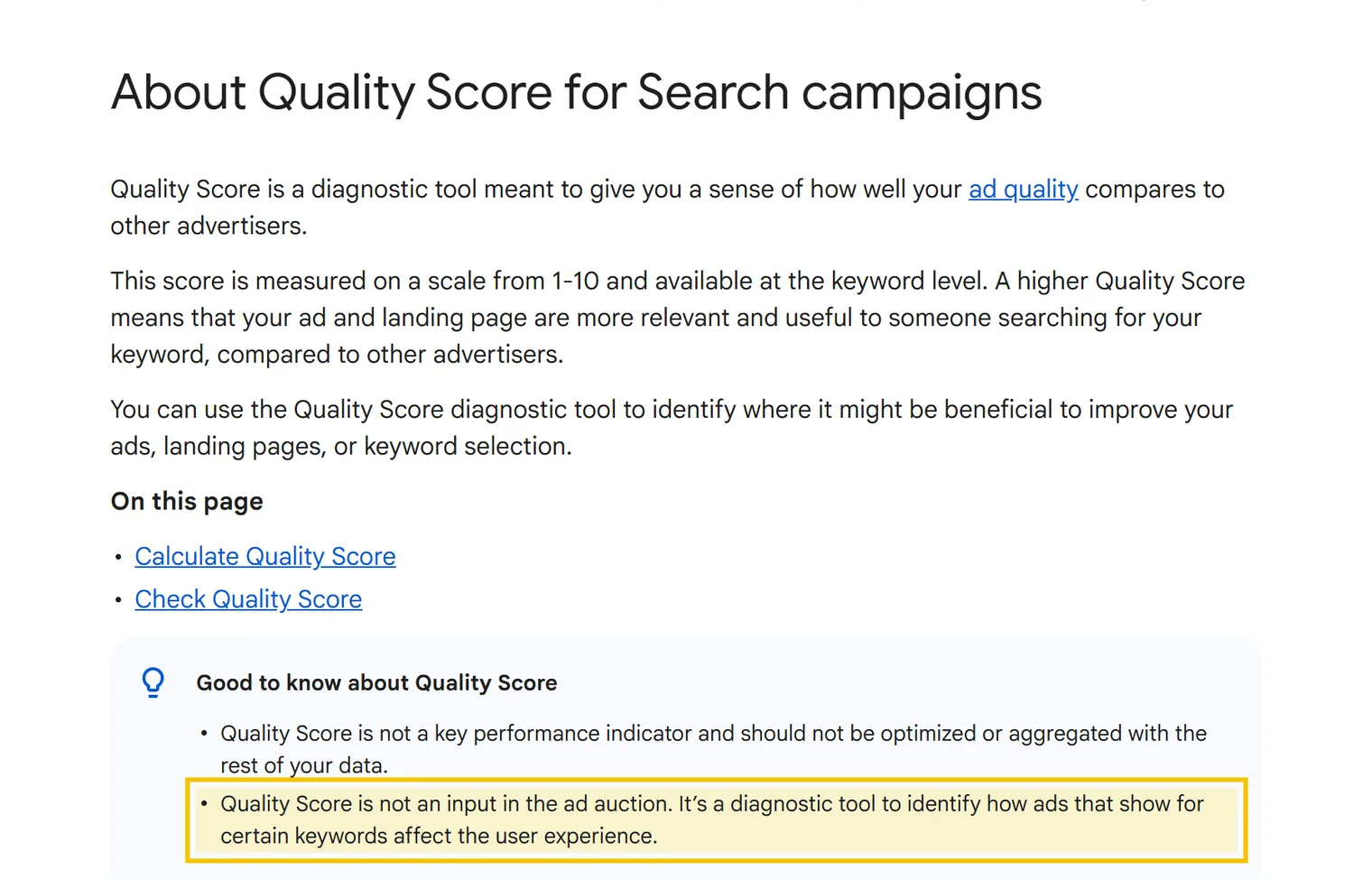
The two move together, though. The same signals that lift your Quality Score also lift your ad quality at auction time, and ad quality is one of the factors in Ad Rank alongside your bid, the context of the search and the expected impact of your assets. Higher Ad Rank means a better position, and often a lower price for it.
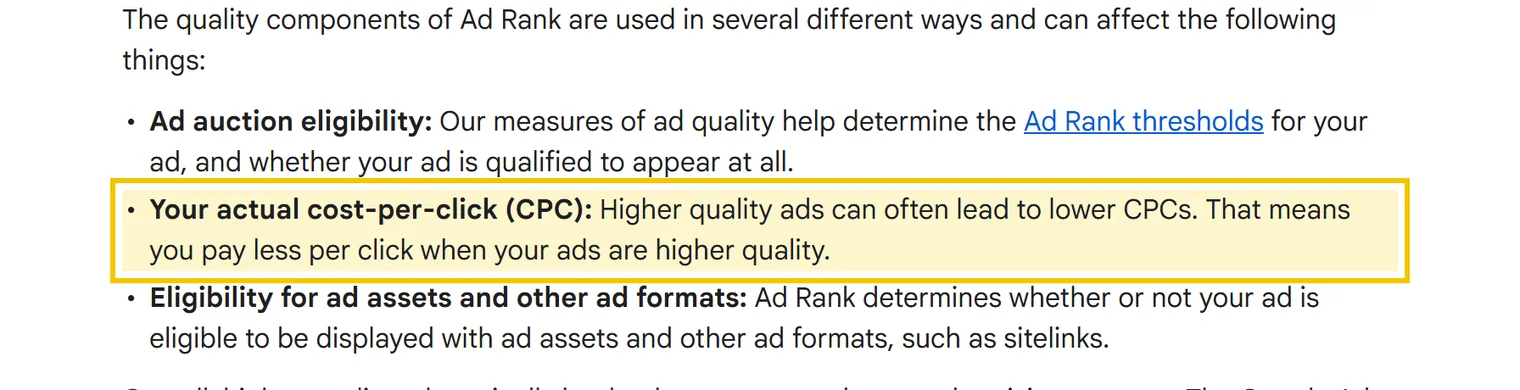
In practice this is why two advertisers can pay very different amounts for the same click. The one with relevant ads and a page built for the search buys the position more cheaply than the one who bids higher and sends people to a generic homepage. Our Google Ads cost guide walks through the rest of the price.
Treat it as a diagnosis, not a target
Google describes Quality Score as a diagnostic tool, not a key performance indicator, and we agree. A keyword with a score of 4 that brings leads at a good price is worth more than a keyword with a 9 that brings none.
The useful question is which component is below average on the keywords that spend the most money. Sort by cost, look at the three columns and you have a list of what to fix first.
It also helps to read the score next to conversion data rather than on its own. A keyword with average ratings and a good cost per lead needs nothing. A keyword with below average ratings and no leads after a few hundred clicks needs a decision, and usually the fix is in the ad group or the page rather than in the bid.
A high score on the wrong keyword is worth nothing
The most common mistake I saw had little to do with the score itself. People choose keywords that are on topic but will never bring a sale. A divorce lawyer targets searches like free divorce forms. A shop that sells 3D printers targets what is a 3D printer. A car parts store targets how to change a tyre.
The ad is then written around that keyword, and Google rewards the match with a high score. The ad shows, people click, and nothing happens, because they came for free information rather than to buy.
A quieter version of the same mistake is a keyword with two intents. An estate agent that only sells flats targets searches like flats in Leeds, which people also type when they want to rent. Ad relevance drops, the page fits only half of the searches, and the score is the least of the problems.
When a low score is fine and when it is not
I have not seen a low Quality Score on its own break a campaign. In some niches a low score is simply normal.
Take a dental clinic that only does Invisalign. Google would like its ads to cover teeth straightening in general, because that is what most people search for. The clinic does not offer anything else, so its ads stay narrow and the score stays low. The leads that do come in are the right ones, and that matters more than the number.
That is true for a few keywords, not for a whole account. Sitting on low scores for months means something in the keywords, ads or pages needs fixing. The opposite extreme does not work either. Trying to get every keyword to 10 out of 10 wastes time that is better spent on the keywords that bring sales.
What I check first when keywords score 3 or 4
Before touching a single keyword I need to understand what the business really sells. More often than you would think, the owners cannot put it into words themselves. One kitchen maker built every kitchen in art deco style, yet the whole account bid on custom kitchens. The fix was keywords around art deco kitchens, with ads and a page to match.
After that I compare the keywords with what the business does and replace the ones that do not fit. A few weak scores in an account are normal. An account where every keyword scores 1 to 3 is a real problem.
What bothers me more is a bloated keyword list. Three hundred keywords for one service is far too many. Most of them never get an impression, and the ones that do bring in searches nobody planned for.
Raising expected CTR and ad relevance
Both usually come down to structure. When one ad group holds forty loosely related keywords, no single ad can match them all, so relevance drops and fewer people click. Splitting the group by intent, with ads written for each theme, fixes both components at once.
Put the words people actually search for into the headlines, and give a reason to click in the first line, such as a price, a timeframe or a concrete offer. Check the search terms report every week and add negative keywords for the searches that will never convert. Every irrelevant impression pulls expected CTR down.
Fixing landing page experience
Send each ad group to the page that answers its search, not to the homepage. If someone searches for divorce lawyer fees, the page should show fees near the top, not a mission statement.
Then check the basics on a phone. The page should load fast, show the offer before any scrolling and make contact one tap away. If you do not have such pages yet, that is exactly what our landing pages built for PPC are for.
Mistakes we keep seeing in audits
Chasing the number with keyword stuffing. Repeating the keyword five times in an ad does not make it more relevant, it makes it worse to read and the click rate falls.
Pausing every keyword below 5. Some of them are the only ones bringing sales, and the score would have improved with a better ad group and page. Look at conversions before you pause anything.
Ignoring the landing page column because it is not inside Google Ads. Of the three components, landing page experience is the one advertisers fix least often, and it is usually the cheapest win. A free audit is a quick way to see which of the three is holding your account back.

Quick answers
What is a good Quality Score in Google Ads?
Seven and above is healthy for most keywords. A few keywords with a lower score are normal, especially in a narrow niche. If every keyword in the account scores low, something is wrong. At the same time, there is no point chasing a 10 on every keyword.
Does Quality Score affect how much I pay per click?
Indirectly, yes. The score is a summary and not part of the auction, but the same quality signals feed into Ad Rank, and better Ad Rank usually means a lower price for the same position.
How long does it take for Quality Score to change?
The score updates as new impressions come in, so on high-volume keywords changes show within days. On low-volume keywords it can take weeks, and a dash means there is not enough data yet.
Is there an account-level Quality Score?
Not officially. Google reports Quality Score per keyword. Averages from third-party tools can hide an expensive keyword with a weak score, so look at the keywords that spend the most first.
Do Performance Max and Shopping campaigns have a Quality Score?
No. Quality Score is reported for keywords in Search campaigns. Shopping and Performance Max rely on your feed, assets and landing pages instead.
Can you fix a low Quality Score for us?
Yes. We start by finding which component is below average on your most expensive keywords, then rebuild the ad groups, ads or pages behind them. Management is a flat fee from $400 a month.
More from the blog
Google Ads conversion tracking, set up so the numbers mean something
What to count as a conversion, primary and secondary actions, calls, forms, enhanced conversions, offline imports, consent mode and the mistakes we find in most accounts.
Read the articleGoogle Ads account suspended? What actually gets accounts back
Why Google suspends ad accounts, how the appeal works, where advertiser verification goes wrong and what never to do after a suspension. From three years inside Google Ads support.
Read the articleWhat PPC means in marketing, and how it differs from SEO
Pay per click without jargon. How the Google auction works, what Quality Score changes and when paid search is the wrong channel for you.
Read the articleFind out what is holding your Quality Score back
Leave your details. We reply within 15 minutes during working hours and book 20 minutes to go through your keywords with you.
No spam. One call and a specific list of fixes.